Building Zero-Downtime CI/CD Pipelines at Scale

From Manual to Automated
Manual deployments once consumed over two hours of engineering time per release, involving SSH sessions, hand-edited configuration files, and a deployment checklist shared across a team chat channel. The process was error-prone, stressful, and limited releases to once a week during low-traffic windows. The transformation to fully automated pipelines reduced deployment time to under eight minutes end-to-end, enabling the team to ship confidently more than fifteen times per day.
The business impact extended beyond speed. Developer satisfaction surveys showed a 40% improvement in deployment confidence. On-call incidents related to deployments dropped by 75%, and the team reclaimed hundreds of engineering hours per quarter that were previously spent on release coordination and manual rollbacks.
Pipeline Architecture
Jenkins declarative pipelines with shared libraries handle the bulk of internal services. Shared libraries encapsulate common stages, including checkout, build, unit tests, integration tests, static analysis, container image creation, and deployment triggers. GitHub Actions handles open-source repositories and lighter workloads, with reusable workflows that mirror the Jenkins stage structure. The two systems integrate through webhook events and shared artefact registries, allowing teams to choose the tool that fits their workflow while maintaining consistent quality gates across both platforms.
Blue-Green and Canary Deployments
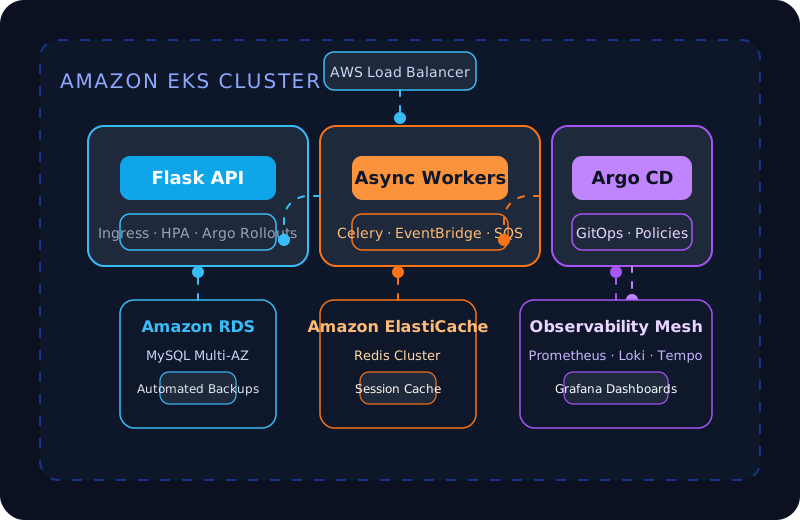
Argo Rollouts enables progressive delivery on Kubernetes by managing the traffic shift between old and new versions. Blue-green deployments maintain two identical environments, switching traffic atomically after the new version passes readiness checks. Canary deployments start by routing a small percentage of traffic to the new version and incrementally increase based on analysis runs. These analysis runs query Prometheus for error rates, latency percentiles, and custom business metrics. If any metric breaches its threshold during the canary phase, Argo Rollouts automatically triggers a rollback, ensuring users never experience degraded service for more than a few minutes.
Security Gates
Security is not an afterthought but a pipeline stage. SonarQube performs static application security testing (SAST) on every commit, flagging code-level vulnerabilities and quality issues. Dynamic application security testing (DAST) runs against ephemeral preview environments, scanning for runtime vulnerabilities like injection flaws and misconfigured headers. Dependency vulnerability checks audit every third-party library against CVE databases, blocking builds with critical findings. Trivy scans container images for OS and application-level vulnerabilities, while OPA Gatekeeper enforces cluster-level policies that prevent deployment of unsigned images, privileged containers, or workloads without resource limits.
Pipeline Metrics
- Deployment frequency increased from weekly to 15+ deployments per day.
- Lead time reduced from 60 minutes to under 15 minutes end-to-end.
- Change failure rate dropped below 2% with automated rollback detection.
- Mean time to recovery reduced by 65% through automated incident response.
- 100% of production deployments pass security scanning and policy gates.
The pipeline continues to evolve. Current initiatives include adding ephemeral preview environments for every pull request, implementing feature flag integration for decoupling deployment from release, and expanding canary analysis with custom business metrics that reflect real user impact rather than purely technical signals.
tags:
Recent Posts