
Building an Observability Stack for Live Sports Telemetry

The Challenge of Real-Time Sports Data
Live sports platforms demand sub-second observability across every layer of the data pipeline. Match data flows through Kafka topics, processing services parse and enrich events in real time, and delivery APIs push updates to millions of concurrent consumers. With strict latency SLAs measured in milliseconds, any blind spot in the pipeline can cascade into degraded fan experiences and missed business-critical events. Traditional monitoring approaches that poll every 60 seconds simply cannot keep up.
Building an observability stack for this environment required rethinking how metrics, logs, and traces are collected, correlated, and acted upon. The goal was a unified platform where an on-call engineer could move from an alert to the root cause in under two minutes, regardless of whether the issue originated in Kafka consumer lag, a slow database query, or a misconfigured deployment.
Architecture Overview
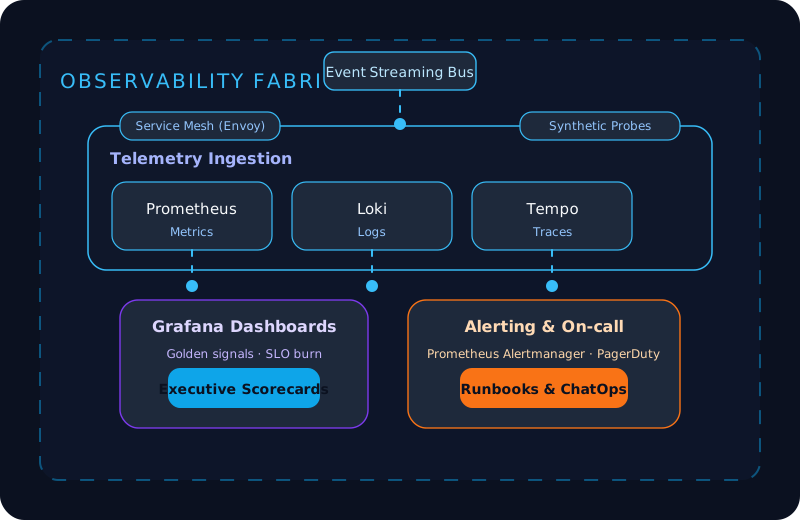
Prometheus Operator manages over 150 scrape configurations declaratively through ServiceMonitor and PodMonitor custom resources. Loki ingests structured logs from all Kubernetes workloads using Promtail agents deployed as a DaemonSet, with log labels automatically derived from Kubernetes metadata. Tempo provides distributed tracing with automatic span correlation across services, enabling engineers to follow a single match event from ingestion through processing to delivery. Grafana ties all three data sources together, allowing seamless pivoting between metrics, logs, and traces from a single dashboard panel.
Metrics That Matter
The stack follows the golden signals approach: latency, traffic, errors, and saturation. Custom recording rules pre-aggregate high-cardinality metrics into actionable summaries, reducing query time from seconds to milliseconds on dashboards that refresh every five seconds. Grafana dashboards surface match-event latency percentiles, error budgets calculated against monthly SLOs, Kafka consumer group lag, and processing queue depths. Each dashboard panel links directly to related log queries and trace searches, eliminating context switching during incidents.
Alerting Without Noise
Alertmanager configuration uses routing trees to direct alerts to the right team based on namespace labels and severity levels. Inhibition rules prevent cascading alerts when an upstream dependency fails, ensuring on-call engineers focus on root causes rather than symptoms. PagerDuty integration delivers high-severity alerts with contextual runbook links embedded in the notification. By implementing severity-based grouping and de-duplication windows, alert fatigue was reduced by 70%, and the mean time to acknowledge dropped from 12 minutes to under 3 minutes.
Operational Checklist
- Prometheus Operator with Helmfile for declarative scrape configuration management.
- Loki and Tempo for correlated log and trace analysis within Grafana.
- Alertmanager pipelines with PagerDuty reducing noise by 70%.
- Custom Grafana dashboards tracking match-event latency under 200ms SLA.
- AWS Managed Prometheus for long-term metric storage and cross-region federation.
The observability platform processes over 2 million metric samples per second and ingests 500 GB of logs daily. By investing in recording rules, structured logging standards, and trace-based alerting, the team achieved a state where most incidents are detected and diagnosed before users notice any degradation.
tags:
Recent Posts
AWS Cost Optimisation: Cutting Cloud Spend by 35%
July 22, 2024